
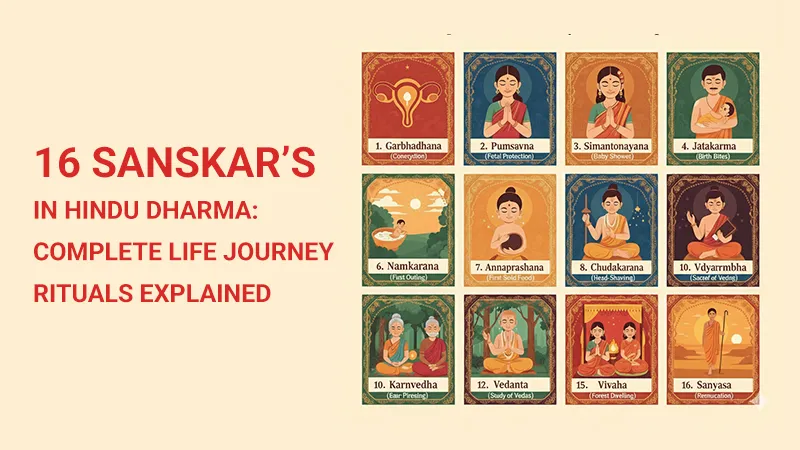
Hindu Dharma considers human existence as a holy process that follows discipline, values and spiritual consciousness. This is also a journey that is characterized by 16 Sanskar in Hinduism which are life cycle ceremonies that are used to fine tune character, enhance responsibility, and bring people close to dharma at each life stage. These rituals bring order, purpose and continuity, between birth and death. In a practical manner, these Sanskar can be understood to ensure that the culture of modern families living in Ahmedabad is not eroded by civilization. This chapter and verse guide teaches all the sixteen Sanskar’s, their importance, and the right time to perform them all and how the families of the present day can adhere to correct Sanskar Vidhi and keep the custom by good life cycle rituals.
What Is Sanskar’s and Why They Matter
Sanskar’s are religious ceremonies which are stated in the texts of Veda, and they are also meant to purify body, mind and intellect. Sanskar is the word that means refining or impression, every ritual makes some positive impressions on the life of a person. The 16 Sanskar’s of Hinduism are not fixed traditions but spiritual benchmarks which foster discipline, appreciation and moral existence. In Ahmedabad where joint families, nuclear families, and modern ways of living exist, Sanskar’s is a form of cultural bridge between the generations. According to Pandit Chetan Purohit, these rituals are not aimed at controlling the life of human beings with fear but with awareness, and hence these rituals are applicable even nowadays.
Garbha Dhan Sanskar – Beginning of Life
The first of the 16 Sanskar’s in Hinduism is called Garbha Dhan Sanskar which is performed prior to conception. It represents conscious parenthood, responsibility and wishes to have a healthy and good child. It has traditionally been done upon marriage where couples have intentions of having a family. This Sanskar is simplified in contemporary Ahmedabad families, with the emphasis being more based on prayer and will than the rites of passage but still adhering to proper Sanskar Vidhi.
Pumsavan Sanskar – Protection of the Child
Early pregnancy is celebrated by means of Pumsavan Sanskar. It is aimed at the physical and psychological health of the unborn infant and the mother. It signifies concern, safety and emotional attachment in pregnancy. Families today can do a small ritual at home that Pandit Chetan Purohit guides them on, a combination of tradition and medical awareness.
Simantonnayan Sanskar – Emotional Well-being of the mother
Later months of pregnancy Sanskar is performed as Simantonnayan Sanskar. It is concerned with the emotional wellbeing of the mother and good growth of the child. The mother is blessed by family members, and this brings comfort and support. The ritual has remained significant in Ahmedabad families since it is a family-based ceremony that focuses on love and optimism.
Jatakarma Sanskar – Welcoming the Newborn
Jatakama Sanskar is practiced right after birth. It signifies the child getting into the world and there are blessings of long life and wisdom. Usually the mantras are recited, and the father plays the role of performing symbolic grateful acts. This Sanskar is an indication of life cycle ceremonies and the involvement of family towards the newborn.
Namkaran Sanskar – Naming the Child
The child is formally named by Namkaran Sanskar, according to astrology, nakshatra and family tradition. It is among the most popular practiced Sanskar’s. The name is considered to influence personality and life direction. Pandit Chetan Purohit is the person who takes the families through proper Sanskar Vidhi to come up with meaningful names that are in line with tradition and modernity.
Nishkraman Sanskar – First Outing
Nishkraman Sanskar is the first occasion when the child goes outside the house mostly to a temple or a natural place. It represents entry into the outside world and the existence of God. Some Ahmedabad families, albeit in a simplified form, still do this ritual nowadays.
Annaprashan Sanskar – First Solid Food
Annaprashan Sanskar is the first intake of solid food of the baby. It is a symbol of development and food. The central part of this ritual is family blessings. This Sanskar continues to be a family and a happy family get-together, and a life cycle ceremony.
Chudakarana Sanskar – First Haircut
Chudakarana Sanskar is a haircut on a child when it first gets cut, and it signifies cleansing and re-birth. It is an expression of abandoning the effects of the past and starting afresh. Most families in Ahmedabad carry out this ritual within the temples or at home with minimal ceremonies.
Karnavedha Sanskar – Ear Piercing
Karnavedha Sanskar is done because of health, discipline and cultural reasons. It is performed traditionally in childhood and is considered to help to maintain physical and mental balance. Although the contemporary healthcare environment is also applied today, there are still some families practicing ritual aspects as a part of Sanskar Vidhi.
Upanayana Sanskar – Spiritual Education
Upanayana Sanskar is the commencement of formal schooling and spiritual accountability, which is traditionally male. It represents discipline, education and restraint. Some families today revise their values, though less frequently, by means of educational blessings and spiritual directions.
Vedarambha Sanskar – Beginning of Learning
Vedarambha Sanskar means the beginning of learning, and this is reading and writing. It is a show of respect for knowledge and learning. Families in Ahmedabad are quite prone to this in addition to school admissions or Saraswati Puja.
Samavartana Sanskar – Completion of Education
Samavartana Sanskar is the end of formal education and the preparation to start a professional life. It focuses on accountability and morality. Its ideas remain applicable to young adults at the beginning of their career.
Vivaha Sanskar – Marriage
One of the most important life cycle rituals is vivaha Sanskar which symbolizes partnership, duty and responsibility towards the society. It brings together families and traditions. Pandit Chetan Purohit carries out matrimonial ceremonies with the help of genuine Sanskar Vidhi, which is modified to contemporary ways of life.
Vanaprastha Sanskar – Transition to Detachment
Vanaprastha Sanskar is the step-by-step withdrawal of material duties and attention to spiritual life. Although symbolic in the present times, its ideals of symmetry and reflection are applicable in the context of mid-life transitions.
Sannyasa Sanskar – Renunciation
Sannyasa Sanskar is the ultimate renunciation and devotion to spiritual life. It is hardly used today but still; it is a pillar in philosophy of the 16 Sanskar’s in Hinduism.
Antyeshti Sanskar – Final Rites
The last rite is called Antyeshti Sanskar which celebrates the departure of the soul. It is a show of respect, gratitude and acceptance in life cycle. This is a ritual that is carried out with honor and respect to the tradition by families in Ahmedabad as a rite in the life cycle.
How Modern Ahmedabad Families Can Uphold Sanskar’s
Most of the Sanskar’s may not be observed as they were traditionally in modern families, yet the idea they expressed can be learned to be applied selectively and simplified. Pandit Chetan Purohit assists the families in adjusting to Sanskar Vidhi but without the spiritual essence.
Why Choose Us
Pandit Chetan Purohit is a reliable source of performing and directing Hindu life cycle religious rituals in Ahmedabad. Pandit Chetan Purohit is knowledgeable about the 16 Sanskar’s in Hinduism, and his explanations are clear, rituals are authentic and his advice is practical and relevant in the contemporary life of the family. He does not emphasize the strictness of traditions but instead what is significant because he thinks that families should respect tradition in a more aware way. Since childhood and even during marriage and send off rituals, Pandit Chetan Purohit honors families through every phase of life cycle in a respectful, clear, cultural manner.
Conclusion
The Hinduism religion has 16 Sanskar’s that are a total spiritual system that directs the life of a human being from conception to the final rites. Every Sanskar has values which promote discipline, thankfulness, and responsibility. To the contemporary Ahmedabad family, learning these rituals enables cultural identity as it acclimatizes to modern living. Rituals do not always have to be fancy but understanding the purpose of rituals binds families and continuity of spirituality. These Sanskar’s are applicable, significant and very fulfilling through generations with due guidance and care in their application.
Consult for Sanskar Ceremonies with Pandit Chetan Purohit for authentic guidance on life-cycle rituals. Call +91 9924635307 or email chetanpurohit2020@gmail.com today.
Key Takeaways
- Hinduism has 16 Sanskar’s, which are the totality of spiritual constructs that determine the life of an individual starting at conception to the last rites.
- Every Sanskar is significant and promotes moral values, discipline and responsibility with the help of the systematic life cycle rituals.
- Simplified eligible Sanskar Vidhi can be used by the modern Ahmedabad family without losing spiritual value.
- Sanskar’s do not necessarily need to be done in an elaborate way but knowing their purpose assists in the continuity of the culture between the generations.
- Pandit Chetan Purohit is also relied upon as having genuine guidance and practical implementation of Hindu Sanskar’s that is adjusted to the modern-day family so that it can fit in the traditional context.